WORKSHOP 1
Cultural History as Architecture - Visceral Board
In this workshop, students will:
- identify the genius loci/ key character/ essence of the site,
- extract the tangible and intangible elements of the site history and cultural history through visuals,
- diagrams and sketches, map out and transform the tangible and intangible elements that extracted from the site into a visual narrative,
- convey/ communicate findings and interpretations via visual and written narrative

Reflection
In this workshop, I am able to identify the genius loci of the place and determine the main focus of my narrative which is stigma and abandonment. Through creating the visceral board, I am able to understand the general feeling or poetic I am aiming for in the design of interpretive center.
WORKSHOP 2
Landscape In/To Architecture
In this workshop, students will:
- Understand contextual at macro and micro level.
- Understand context at micro level by exploration, creating solutions /suggestions etc
- Understand why/ how landscape connection is crucial to the built structure and built environment, in addition to understand scale, spatial, form, materiality relationships.
- Analyse given site data and respond to it
- Produce a meaningful site plan with site context

Reflection
In this workshop, I have learned how to create a site plan that is able to be understood clearly. I am also able to explore the relationship of the site to the surrounding context through the workshop, which enhances my understanding on the importance of acknowledging and respecting the surrounding context.
WORKSHOP 3
Structure as Architecture
In this workshop, students will:
- Integrate basic structural concept/ system into the design scheme
- Translate structural ideas into physical development models
- Apply structural system to design concept
- Produce structural concept diagram

Reflection
In this workshop, I am able to learn different ways of construction and identify the suitable construction method - frame construction for my design with the help and guide from my tutor. I am also able to explore the idea of structure as a type of expression in architecture and incorporate it in my design.
WORKSHOP 4
Environment as Architecture
In this workshop, students will:
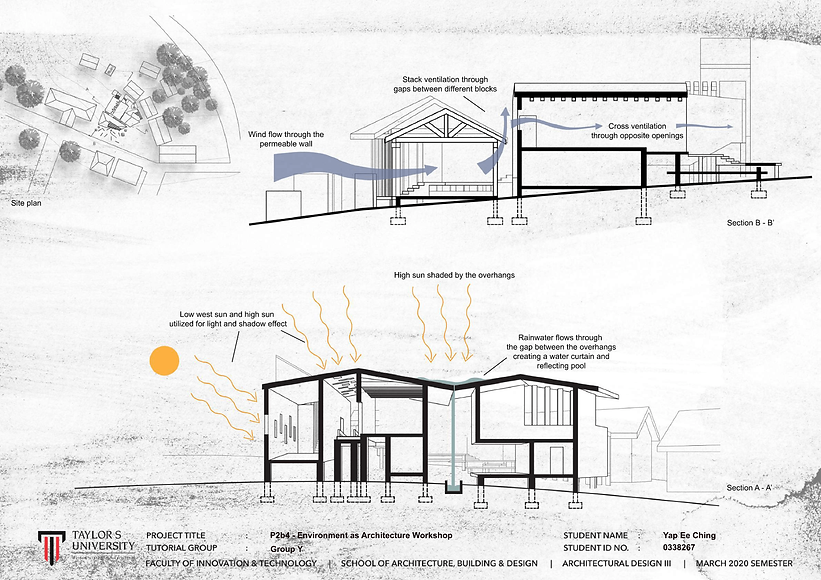
- Understand the environmental aspects of the site to create the design strategy for the building concept.
- Apply passive design strategies to design concept
- Produce climatic response diagram/s
Reflection
In this workshop, I am able to explore the relationship of the environment with the design, for instance, wind, sun, rain and vegetation. Different ways of using the environmental elements as part of the design is explored, for instance the water curtain and reflecting pool, and simple passive design strategies are also considered to be incorporated into the design, for instance, natural ventilation, shading and natural lighting, which encourages energy saving and to achieve thermal comfort.